


How Movers Keep Your Piano Safe
"*" indicates required fields

Case Study: Moving a Baby Grand Piano Up a Tight 2nd-Floor Stairwell
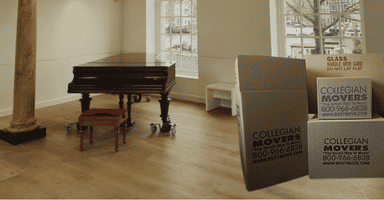
Moving a piano isn’t just about heavy lifting; it’s about physics, specialized equipment, and extreme precision. Recently, Glenn S. approached Collegian Movers with a high-stakes challenge: relocating his cherished baby grand piano to a second-floor studio in Connecticut, a move that involves a narrow landing and a 90-degree turn.The Challenge: Navigating “Impossible” Architecture
Most local movers shy away from second-floor piano moves because the margin for error is zero. Glenn’s move presented three major obstacles:Weight & Balance: A baby grand piano weighs between 500 and 800 lbs, with a center of gravity that shifts dangerously on inclines.The Landing Bottleneck: A tight turn on the stairs meant the piano had to be maneuvered on its side (the “lyre” and legs removed) with less than two inches of clearance.Surface Protection: The destination featured historic hardwood floors that required 100% protection from high-pressure casters.The Professional Strategy: How We Did It
To ensure a damage-free relocation, our team utilized a multi-step Professional Piano Moving Protocol:1. Preparation and “Skid” Mounting
We didn’t just wrap the piano; we disassembled the lid, pedals, and legs, securing the “rim” to a heavy-duty piano board (skid). This creates a flat, stable surface that allows the instrument to slide safely on specialized tracks.2. Specialized Equipment for Inclines
Navigating stairs requires more than muscle. We used:- E-track Strapping: to lock the piano to the skid so it cannot shift.
- Moving Dollies with Non-Marring Wheels: To protect the second-floor flooring upon arrival.
- High-Density Moving Blankets: Double-layered to prevent “rub-burn” against narrow door frames.
3. The “difficult conditions” Maneuver
By calculating the “swing radius” of the landing beforehand, our team was able to hoist and pivot the piano at the exact angle needed to clear the banister without touching the walls.Client Success: A Google 5-Star Review
5-Star Review: Moved a baby grand piano under difficult conditions and did a professional job. I recommend these guys for your move.” — Glenn S.
Suggested Next Steps for Piano Owners:
If you are planning to move a piano in Connecticut or the surrounding area, don’t leave it to chance. Follow these steps:- Measure Your Clearances: Check the width of your stairwells and the height of your door frames.
- Verify Insurance: Consult with your homeowner’s insurance to ensure coverage for musical instruments.
- Get a Technical Quote: Request a Piano Moving Quote and mention any stairs, turns, or grass-surface obstacles.
Related Services:
Collegian Movers offers a wide range of moving services to ensure a successful move with your piano. These services include:- Packing – Collegian Movers uses high-quality packing materials to protect the piano during transport.
- Transportation- The team uses specialized equipment and techniques to move the piano safely and efficiently.
- Unpacking – Collegian Movers also offers unpacking services, which include reassembling the piano and placing it in its new location.

Moving Services
Moving Company Reviews


September 3. 2026
/ Google Review
Thomas R
Dwight and Kidany did an awesome job moving my furniture! They were right on time and very professional! I highly recommend Collegian Movers!

September 26. 2025
/ Google Review
Barbara Roche
Collegian moved my sister in law's furniture from one assisted living venue to another recently. They were cordial and efficient and I will use them again for any future moves that may come up as it truly was a hassle free and fairly priced experience.

September 22. 2026
/ Google Review
Michael Cardillo
Had a very positive experience working with Collegian Movers. Kept in communication with me and were very supportive. Dwight, Isaac, and Kidany were awesome. Really nice and easy to work with.

September 20. 2025
/ Google Review
Chris Wagner
We recently hired Collegian to help us move from our apartment to our first home. The movers were on time, professional, and will go the extra mile to help out where they can. They even came with me to our storage unit to help move a large table. Of note, we had several delicate pieces of furniture to move and all were delivered in perfect shape.The booking process was also very easy and no B.S and at the end it was a more than fair price for the work done. I would never even think of calling another moving company after this experience.

September 20. 2024
/ Google Review
Bob Janis
Fantastic service. Isaac and Dwight were professional, fast, and kind. Much recommended!

September 18. 2023
/ Yelp Review
Andrea K
I have nothing but great things to say about Collegian movers. Your team handled everything professionally from the first call to the final delivery. Warren and Mike were excellent and went above and beyond to make the move easy and efficient. I appreciated them being friendly and professional. I found the cost reasonable and would highly recommend Collegian!


